'Magnetic Growth Insights' from 33 SME Property Consultants
Part 1 – Really Knowing Your Ideal Developer Clients
Most property consultants sell technical reports, but after 500+ hours of hosting developer strategy sessions, I've seen that what SME developers actually buy is a good night's sleep.
In this Part 1 of 'Magnetic Growth Insights', I've extracted what 33 of the UK's leading property advisors have learned about moving from a 'commodity provider' to a 'magnetic partner', to help you better consider what, and how, you can solve real challenges and add real value.
Most property consultants make the mistake of marketing their technical services, when their ideal clients are actually shopping for something much more elusive: a good night's sleep.
While some are busy selling concept designs, reports, or finance structures, the SME developer is looking for the "relief" that comes from finding a consultant partner who truly understands their core needs. Their 'end game'.
To become truly magnetic, we need to stop being an off the shelf, cookie cutter commodity provider, and start becoming the antidote to our client's anxiety and need.
Bridging the Optimism Gap: From Deal-Breaker to Deal-Maker
Property professionals are trained in many cases, to see risk. Whilst their SME developer clients, most often are hard-wired to see opportunity.
Understanding your ideal developer client isn't just about knowing their 'category', such as prime resi, affordable family homes or blue-chip office space. It's being familiar with their temperament, personality and thinking process.
"What I learnt quickly, was that developers are very optimistic… they always think they're going to build in a very short period of time and sell off plan. And they're extremely optimistic… the truth and the reality is probably in the middle…"
— Yann Murciano, CEO at Blend
"I knew that they were risk takers by nature, optimists by nature."
— Dean Brown, Founder at Aureum Finance
Most developers want to see the potential. Our fine line, is telling them 'no' without being seen as a 'deal-breaker'.
Developers want solutions brought to them; not just a new list of problems.
I know from my own time as a micro developer, that a proactive professional was a welcomed relief in a space full of micro and macro challenges. Our opportunity appears to be earn respect by offering honest feedback, but in a way that recognises this sense of belief.
However, if my role in a Type 6 Medium Regional (using Inside DB's 8 sub types guide) is as Finance & Operations Manager, and I'm a key stakeholder in the decision, I'll need see information that fits with how I think, and what I look for.
Knowing your ideal client is also about knowing the key supporting decision stakeholders in that firm.
Because developers are wired for opportunity and speed, your communication must reflect that momentum. It isn't just about what you know; it's about how quickly you can translate that knowledge into a straight answer.
The Clarity Filter: Blending Directness with Proof
Getting into the mindset of your ideal developer client should also shape how you present your insights and feedback.
The Land Director who has taken on a punt on a new planner, compared to a boutique developer who is juggling exit strategies on three lives schemes, will have different expectations, in terms of what information they are given to support their thinking.
"What I've learned is that developers generally want a straight answer. They don't want a long-winded planning report… they want to know 'can I do it, how much is it going to cost, and how long is it going to take?' Being able to provide that clarity quickly is what builds the trust."
— Richard Quelch, Director at Q Square
As Richard says, the general view is to opt for brevity and headline figures, but if your ideal client type has strong influencers weighing in, who need supporting evidence, you'll need to find the balance of direct communication, with presenting 'why' this is your belief, especially in an emerging era of Ai-supported reports and data that can be spun out in seconds.
The Tonic Factor: Selling Emotional ROI
Understanding our ideal client as 'people' rather than a commercial entity is vital. It's where we shift our thinking from 'technical services' to 'emotional value' (obviously an internal term!).
Our 'service' in most of the key areas of property, is to remove the developer anxiety, and create value.
"They don't actually want design, they want the certainty and they want the relief that design gives them. So what I wasn't expecting was how much they would value the intangible results. Like, for example, the reduced stress, reduced anxiety."
— Raquel Aparicio Founder at Mar Design
Raquel is actually someone who presents this concept of 'core need' for their developer client really well, with a LinkedIn feed presenting dozen's of posts emphasising with pain points.
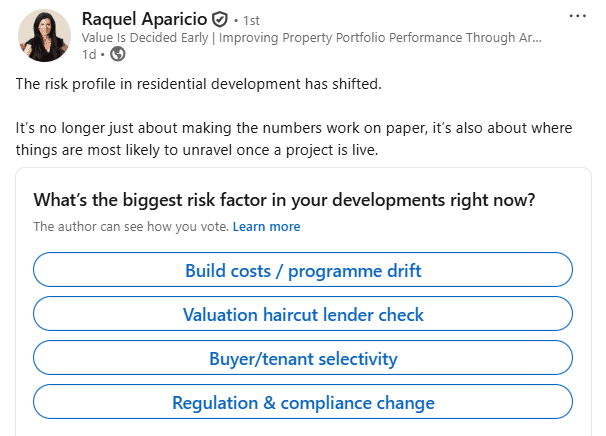
Recent poll from Raquel Aparicio's LinkedIn
To accurately consider their specific 'pain point', you need to know exactly who they are, which means understanding the real human drivers and emotions they experience.
With the majority of SME's, depending on your service, you're very much working to the motivations and tendencies of the 'entrepreneurial nature' of a developer.
"You realize quickly that these aren't just companies, they are individuals putting their own money and reputation on the line. They are entrepreneurs. When you understand that their personal risk is high, your advice changes from being 'technical' to being 'commercial."
— Peter Higginbottom, Managing Director of Planning Insight
So why is this all important?
Property professionals work in a world of service and product commodity. Most are highly skilled and trained in their specific field.
Taking this 'client-first' approach to considering your services, your marketing, your content, your case studies, your introduction at a networking event, positions you differently to your peers, because the majority, as you can imagine, do not take this approach.
Stand out. Do different. Be Magnetic.



Leave A Comment